

The internet of 2026 is a visual-first frontier. We no longer just consume text; we live through images, augmented reality, and short-form video. However, as our digital presence has shifted toward the visual, our search tools have struggled to keep up. For over a decade, the gold standard for finding information about an image was “reverse image search.” But as anyone who has tried to identify a person using legacy tools knows, the results are often more frustrating than helpful.
This gap in the market has been filled by a new generation of technology. Leading the charge is Face2Social, a specialized social media face search platform that does what traditional search engines simply cannot: it looks past the pixels to find the person.

Going beyond simple background matching, this next-generation social media face search deeply analyzes precise biometric features
Why Legacy Reverse Image Search Fails for People
We’ve all been there. You have a photo of someone, perhaps a potential business partner or a dating profile match and you want to verify their identity. You drop the photo into Google or Bing, hoping for a social media profile, and instead, you get a list of “visually similar images” that include people wearing the same color shirt or standing in front of a similar brick wall.
The Problem with “Global Analysis”
Traditional reverse image search uses a method called Content-Based Image Retrieval (CBIR). This technology treats the entire image as a single data point. It analyzes “global features” such as:
- Color Histograms: The dominant colors in the photo.
- Texture and Patterns: The grain of the wood behind the person or the knit of their sweater.
- Shape and Metadata: The general outline of objects in the frame.
Because Google is designed to find products, landmarks, and art, it prioritizes the background over the human. If you are standing in front of a mountain, Google thinks you are searching for the mountain. It doesn’t “know” there is a human face there, and it certainly isn’t trained to distinguish your unique features from the millions of other people who also have mountains in their profile pictures.
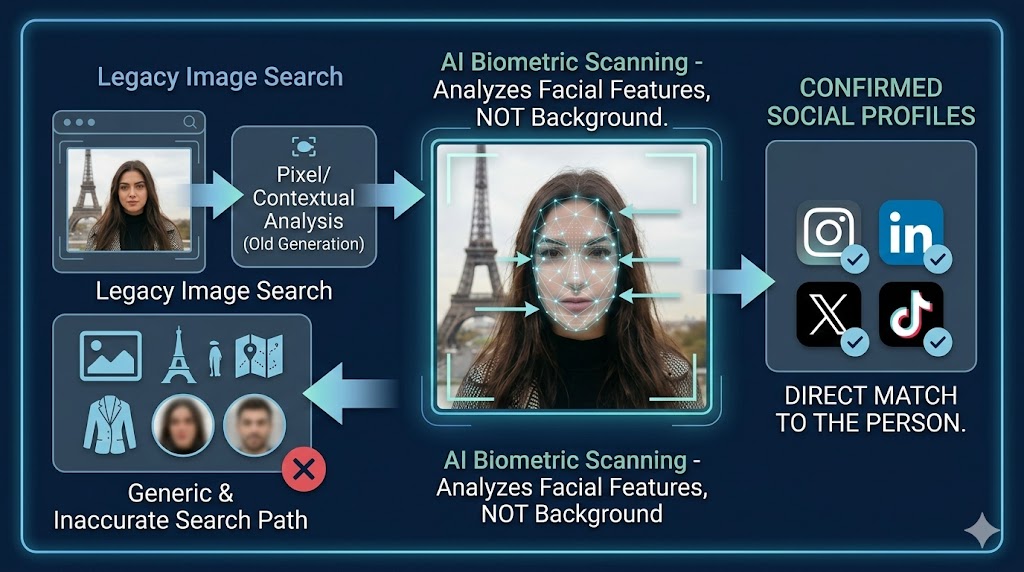
Face2social is the simplest way to search social media accounts by photo supporting such platforms as Instagram, TikTok, Facebook, X
Privacy Restrictions
Furthermore, major tech giants have intentionally limited their facial search capabilities. According to reports from the Electronic Frontier Foundation (EFF), many mainstream search engines have implemented “limited results for people” filters to avoid legal and ethical scrutiny. While this protects privacy in a general sense, it leaves users defenseless against scammers and identity thieves who thrive in the anonymity of the web.
How Face2Social is Reinventing the Search
Unlike legacy tools, Face2Social is built on a “face-first” architecture. It doesn’t care about the background, the lighting, or the scenery. It uses advanced neural networks to perform a biometric sweep of the person in the photo.
The Mechanics of Biometric Mapping
When you use this social media face search, the tool goes through a sophisticated three-step process:
- Face Detection: The AI scans the image to locate a human face, ignoring everything else in the background.
- Landmark Extraction: It identifies dozens of unique “nodal points” – the distance between the eyes, the width of the nose bridge, the shape of the cheekbones, and the length of the jawline.
- Vector Embedding: These measurements are converted into a unique mathematical code, often called a “faceprint” or vector embedding.
Instead of searching for “similar photos,” the system searches its massive database for a matching mathematical signature. This is why you can find social media accounts by photo even if the person has changed their hair, is wearing glasses, or is in a completely different setting than the original image.
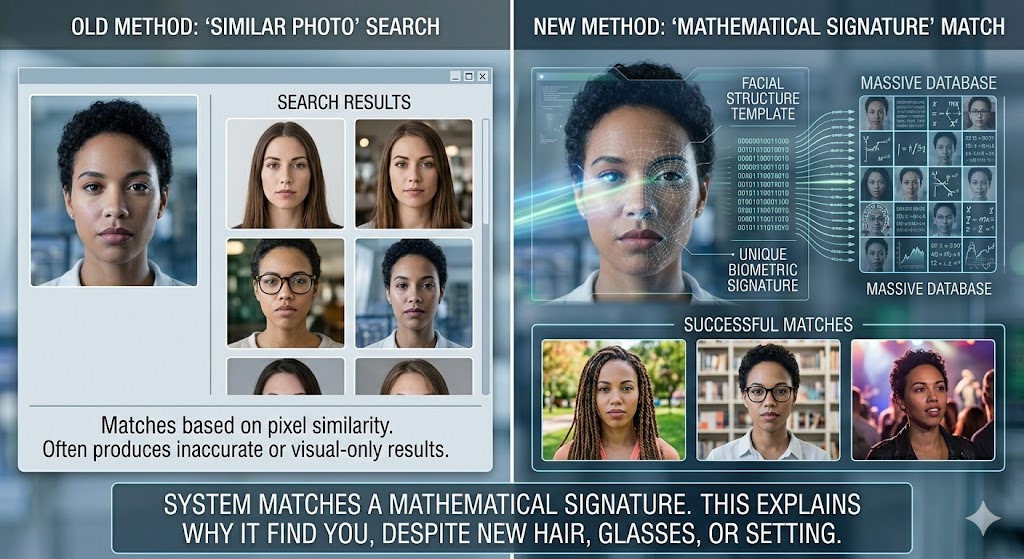
Modern social media finder by photo technology uses unique math to find the right results, even when people look different
Identifying Fakes in the Age of AI
In 2026, the rise of “AI-generated” people has made identity verification more critical than ever. We are living in an era where deepfakes and synthetic identities are used to fuel sophisticated romance scams and financial fraud.
A social media finder by photo is the best defense against these threats. For instance, in the dating world, “catfishing” has evolved. Scammers no longer just steal one person’s photos; they use AI to create a persona that doesn’t exist. By using Face2Social, you can quickly determine if a person has a legitimate, multi-year history on platforms like Instagram or LinkedIn. If a search returns zero results or leads to a completely different name, you’ve just saved yourself from a potentially devastating encounter.
Interesting Fact: According to the Stanford Internet Observatory, over 20% of new profile creations on major social platforms in 2025 were suspected to involve some form of AI-enhanced imagery. Verification tools are no longer optional – they are a survival kit for the modern web.
Professional and Social Utility
The applications for a social media finder by photo extend far beyond security. It has become an essential tool for:
- Networking: You met someone at a busy conference and only remember their face. A quick search can help you find their LinkedIn and send that follow-up message.
- Journalism: Verifying the source of a viral video or image to ensure the person claiming to be an eyewitness is who they say they are.
- Brand Protection: Helping influencers and public figures find accounts that are illegally using their likeness to sell products or spread misinformation.
By providing a direct link between a face and a social profile, Face2Social removes the friction from digital discovery. You no longer have to guess names or scroll through endless “John Smiths.”
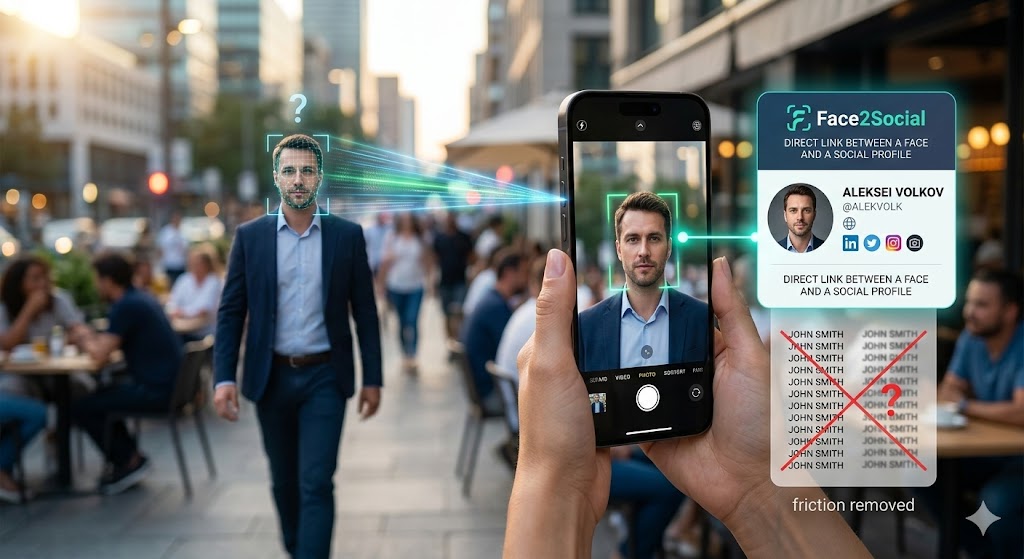
Social media face search technology designed to instantly identify individuals and access their connected profiles across professional and personal networks
The Ethical Balance
As we move forward, the conversation around facial recognition must include ethics. In 2026, the industry has shifted toward more transparent and consent-based models. Leading tools now prioritize the indexing of publicly available social media profiles while adhering to global standards like the EU AI Act.
The goal isn’t mass surveillance; it’s individual empowerment. By giving regular users access to the same technology previously reserved for high-level security firms, we level the playing field. Everyone has the right to know who they are talking to online.
Conclusion
The era of “keyword searching” for people is over. Names are too common, and usernames are too easy to hide behind. If you want to navigate the internet with confidence in 2026, you need a tool that understands the most unique identifier we have: our faces.
Face2Social has proven to be the best new social media face search because it focuses on the human element. It skips the “brick wall” and the “mountain” of Google’s algorithms and goes straight to the source. Whether you’re looking to find social media accounts by photo to reconnect with a friend or to protect yourself from a scam, the technology is now here to make it happen in seconds.
The future of search is visual, biometric, and incredibly fast. Don’t get left behind in the pixels of the past.
