
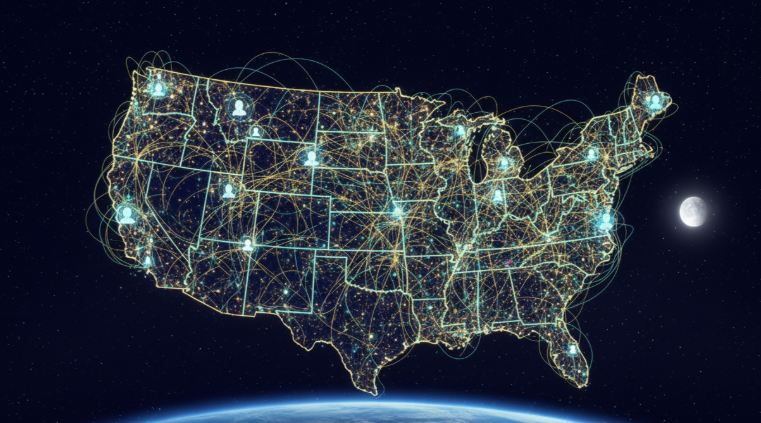
Behind every social media profile lies a raw map of human behavior.
If you have ever wondered why you would track anyone’s Instagram activity – to see what someone has liked, who they followed, and how they interact with the digital world – the answer lies in the layers of human psychology. We all curate a public persona, but our digital footprints, specifically the tiny interactions we think go unnoticed, often tell a much more honest story.
A specific “like” might seem trivial, but a pattern of thousands likes and of hundreds of follows and interactions creates a high-definition portrait of a person’s true interests, political leanings, and hidden vices. But what exactly can this data show us?
Here is the answer – the Socialprofiler research. Here is what 2025 State of U.S. Social Media: What 756 Million Profiles Reveal About American Life tells us about the reality of modern digital behavior.
This massive study, analyzing a staggering dataset of over 756 million profiles across major platforms, strips away the filters to reveal the raw state of American life. From the surprising political habits of Boomers to the shifting hedonism of Gen Z, the findings challenge almost every assumption we have about online behavior.
The Myth of the “Wild Youth”
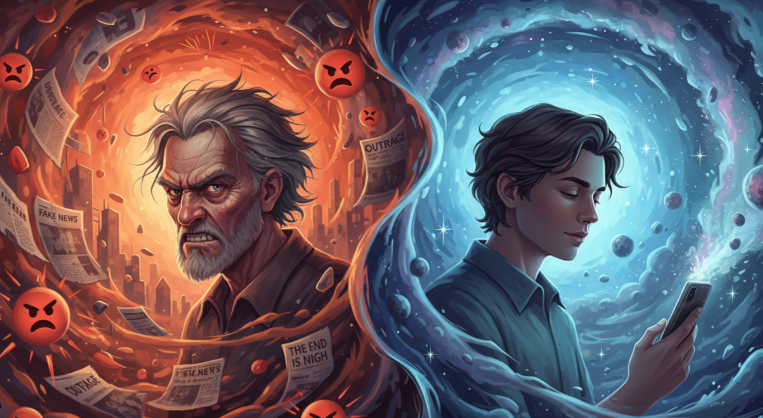
The new generation gap: Rage is aging, while youth seeks peace.
For decades, the prevailing narrative has been that young people are the drivers of online chaos, radicalization, and unrestrained hedonism. Parents worry about what their children are exposed to, and employers worry about the volatility of young hires. However, the data suggests we might be looking in the wrong direction.
According to recent findings, the loudest and most aggressive political debates are not occurring among the youth, but among their parents. A deeper dive into the data, which was also highlighted in a recent New York Post article, reveals that older Americans are the primary drivers of polarization and online conspiracies.
While Gen Z is certainly active, their political engagement tends to focus on broad social justice issues – climate change, LGBTQ+ rights, and inclusivity – rather than the rigid, partisan party rhetoric that dominates the feeds of Gen X and Boomers. The study found that older generations are far more likely to engage with “hot” political content and polarizing conspiracy theories. In contrast, younger users are drifting toward “esotericism” and alternative spirituality rather than hardline political conspiracies.
The Shift in Vices: Alcohol vs. The Screen
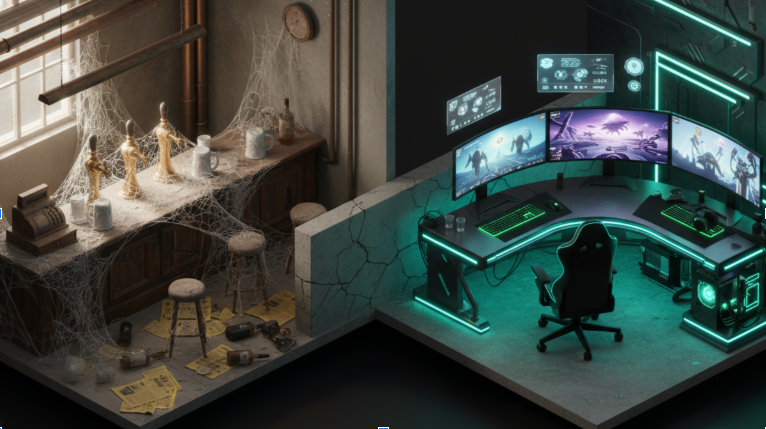
As bars empty out, digital playgrounds and vices fill up.
One of the most fascinating aspects of utilizing an Instagram activity tracker or social media analysis tool is observing how vices evolve. If you were to check Instagram likes for a typical 25-year-old male today versus ten years ago, the results would look drastically different.
The Socialprofiler research indicates a massive cultural shift in hedonism. Generation Z is drinking substantially less alcohol than Millennials. This decline is particularly radical among young men. But human desire for dopamine doesn’t just disappear; it relocates.
While traditional “rock ‘n’ roll” lifestyles involving hard partying and booze are trending down, digital hedonism is trending up. The data exposes a gender divide that flips the script: young women are becoming significantly more engaged with mature content than older generations, while young men show a decreased interest in these traditional pursuits, instead migrating toward different forms of online engagement, such as gaming, niche communities, and unfortunately, different types of radicalization.
This is why a simple glance at a profile is never enough. To truly understand someone’s lifestyle – whether for a dating background check or an employment screen – you need to look at the aggregate data of what they consume daily.
Instagram is a TV, Not a Telephone
Another revelation from the study changes how we should view social networking itself. We tend to think of Instagram as a place to connect with friends. In reality, for the vast majority of users, it has become a broadcast receiver.
The research shows that Instagram functions more like a set of “TV channels” for celebrity consumption than a community network. Most users follow influencers, brands, and celebrities, with actual real-life friends making up a tiny fraction of their “following” list.
This distinction is crucial for anyone trying to analyze a digital footprint. If you see what someone has liked and it’s mostly celebrity content, that is standard behavior. However, the type of celebrity – whether it’s a fitness guru, a political firebrand, or a fringe conspiracy theorist – reveals the “programming” that person subjects themselves to every day. As Psychology Today often notes, the media we consume passively shapes our worldview more aggressively than the interactions we seek out actively.
The Hidden Risks of “DIY” Investigations

Trying to manually track algorithms is like finding a needle in a digital haystack.
Given these complexities, many people attempt to play detective themselves. You might try to manually check Instagram likes, scroll through following lists, or create “finsta” accounts to monitor someone. This “Do It Yourself” approach is fraught with problems.
First, it is incredibly time-consuming. Scrolling through thousands of follows to find a red flag is like looking for a needle in a digital haystack. Second, algorithms are personalized. What you see on someone’s profile might be different from what they see, or what their activity reveals.
Most importantly, manual snooping lacks context. You might see a follow and panic, not realizing it’s an ironic follow or a remnant from five years ago. This is where professional social media screenings become essential. As detailed in recent industry discussions, smart individuals and companies are ditching DIY research for professional tools that can aggregate, analyze, and contextualize data without the bias or error of manual checking.
What Your “Follows” Say About Your Mental State
One of the unexpected findings in the 2025 dataset was about mental health. There is a stereotype that Gen Z is the “therapy generation,” constantly posting about anxiety and self-care.
However, the data shows that older social media users actually demonstrate deeper engagement with mental health topics than Gen Z. This could be interpreted in two ways: either older generations are increasingly struggling and seeking help online, or they are finally catching up to the destigmatization of mental health that younger generations started.
Conversely, younger men are showing a surprising pivot toward religious conservatism, specifically Islam, in larger numbers, while traditional religions are losing ground. This highlights how digital behavior can serve as an early indicator of significant ideological shifts that might not be visible in face-to-face interactions until much later.
The Economic Divide: Luxury vs. Survival

Our digital carts are full of contradictions: half luxury dreams, half survival fears.
Social media has always been a highlight reel, but the cracks are showing. The research points to a potential economic stratification within generations. While many users utilize platforms to perform success – posting luxury goods, travel, and status symbols – there is a growing undercurrent of “survivalist” content.
Interest in frugality, side hustles, and financial survival is rising alongside the luxury content. This duality suggests that for many, social media is a tool for escapism. Understanding this context is vital. If you are an employer looking at a candidate, distinguishing between “aspirational” follows (luxury cars, mansions) and “behavioral” follows (gambling, high-risk financial speculation) is key. The study notes that older generations are actually more prone to financial risk-taking and extreme sports, challenging the idea that youth equals recklessness.
Why Professional Analysis Matters
In an era where we generate 756 million profiles’ worth of data, the “digital self” is often more detailed than the “physical self.” Whether you are a parent concerned about who is influencing your child, a person entering a new relationship, or a business owner protecting your brand, reliance on surface-level observation is negligent.
Platforms like Pew Research Center have long documented the rise of digital footprints, but the depth of data available now through specialized tools allows for a much more granular understanding. It is not just about what people post; it is about what they consume.
The Harvard Business Review has discussed the “attention economy” for years, but we are now in the “intention economy.” What you click on is what you intend to bring into your life.
The Bottom Line
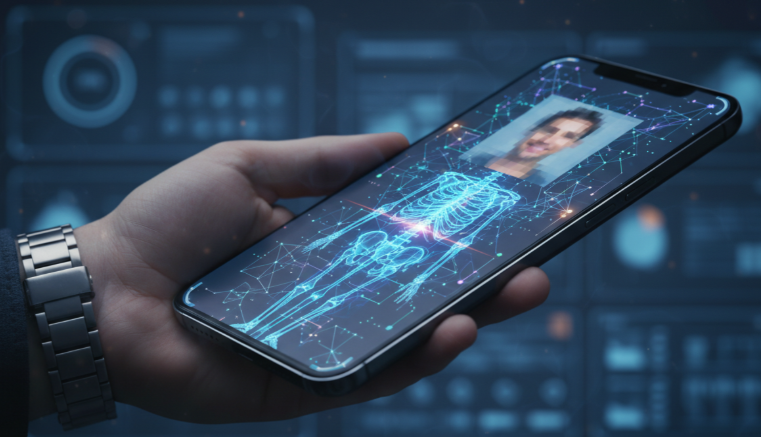
In the age of information, the ultimate safety tool is clarity.
The 2025 Socialprofiler research paints a picture of a society that is complex, contradictory, and deeply revealing. We see older generations driving polarization while younger generations redefine hedonism. We see men and women drifting apart in their digital interests, and we see the death of the “social” network in favor of the “media” network.
If you are serious about understanding who someone truly is, you cannot rely on intuition or a quick scroll through their grid. You need data. You need to understand the hidden signals in the noise.
For those ready to move beyond guessing and start knowing, performing a comprehensive Social media background check is the only way to get the full picture. The data doesn’t lie, but you have to know how to read it.
As we move further into this digital age, services that provide these insights will transition from “nice-to-have” to essential safety tools. Whether for TechCrunch-style analysis of tech trends or personal safety, the power is in the profiles. Don’t leave your understanding of the people around you to chance – leave it to the data.
